Saturday, 20 April 2019

The Flea Market Find

       It has been an even longer gap since my last post but I have been inspired by new friends who also share the passion of keeping memories alive. So to mark my return to this blog, I thought I would share the story of someone who was not part of my family, nor a member of our Field Ambulances. 
Many years ago, I visited a friend in the Bracknell area and we spent an afternoon in Windsor. Whilst there, a Flea market was in full swing and we took some time to peruse the stalls. This is where I found this picture.


When I bought it, it was very dusty, in a broken frame  and very unloved. But something drew me to it. The name "Norman" was written in the corner, and there was a photographer's stamp from Redhill.  I took it home, cleaned it up a bit and put it in a new frame, and then spent some years looking at it, and wondering who Norman was, and where he came from. Eventually, I thought I should do  bit of investigating.
First stop, the uniform. Cap, collar and rank badges indicated he was a very young Second Lieutenant of the Queen's (Royal West Surrey) Regt. It was also quite a late style of uniform. I also found that the photographer, Ernest Jenkins of London Rd, Redhill, Surrey was in business from 1900 to 1934. So now I knew the young Norman probably came from that area.
On a whim, I searched "Soldiers Died" and the CWGC records and found one Norman from that Regiment who had been killed in 1918. This was 2nd Lt Norman Henry Towes of the 7th Bn, son of William Henry and Minnie Ethel Towes, of Redhill, Surrey. It seemed I had hit the jackpot . Of course, the lad in the photo may have survived the war, and was not 2nd Lt Towes at all, but after some more digging online, and a visit to the NAM to find his records, I was pretty convinced. 
I am a member of Ancestry, and so wondered if there was anyone on there who had Norman on their tree. Again, as luck would have it, I did find a descendant although not a direct one. Norman turned out to be an only child and both parents died in 1947 and 1956 respectively. I can only wonder how his photograph, once proudly displayed on a mantelpiece, found it's way to a flea market.


    So this is young Norman Henry Towes, born April 1899 in Redhill Surrey. His father was a Train Driver and they lived in St John's Road.  Norman became a Clerk when he left school but at age 17yrs and 10 months, he volunteered for service and was attested into the 32nd Training Reserve Bn on 28 May 1917 when just 18.
He must have showed some promise as he was selected for Officer Training, and commissioned into the 7th Bn Queen's on the 4th September 1918. On the 8th October he was landing on French soil to join his battalion on the Front. He survived less than a month as on the 4th November he was killed in action during the attack on the Sambre Canal, the same day and the same battle as Wilfred Owen. Norman was 19. A week later, the war ended.

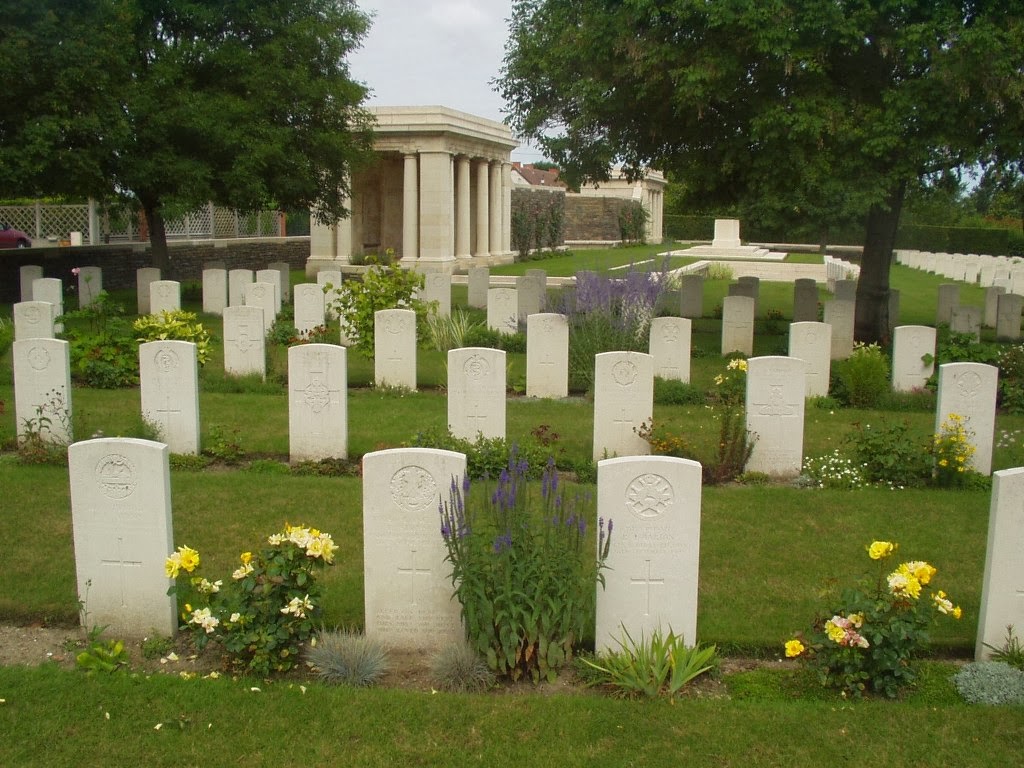
    His grave is found in the Poix-du-Nord Communal Cemetery Extension, a small cemetery about 8k south of Le Quesnoy. His parents chose the following inscription to be placed on his headstone;

To Live In Hearts of Those We Love Is Not To Die

He has no one left to love him, but I will remember him, and his photograph is now on my shelf. One day I will go here to visit his grave and pay my respects.


Wednesday, 19 October 2016

The Cambridgeshire Regt and the Schwaben Redoubt.

The Territorial Army has often been the butt of many a joke - "Saturday Night Soldiers", "Weekend Warriors" and the awful "STAB", often used by Regular soldiers who have had little contact with the TA/Reserve. However, the First World War changed all that and much like operations in Iraq and Afghanistan have changed opinions of today's Reserves, the TF regiments soon had the opportunity to prove that they could be taken seriously as professional soldiers. The Cambridgeshire Regt was one such regiment. A true "county" regiment, it had been raised from Volunteer Battalions and Militia when the TF came into existence in 1908. They were mobilised for service two days after their Summer Camp ended and were sent to the Western Front in February 1915. At the end of August 1916, they arrived on the battlefields of the Somme as part of 117 Bgd, 39th Div.
The Schwaben Redoubt was a maze of strongly defended trenches and strongpoints which dominated the lines around Thiepval. On the first day of the Somme battle it had been attacked by the 36th (Ulster) Div who were successful in taking it - one of the few divisions to complete their objectives.But because the flanking divisions did not have the same success, the Ulstermen were left isolated and were soon cut off, the redoubt falling back into German hands the next morning. 

There were continuing attempts to regain the redoubt and finally on 26th September, the 18th (Eastern) Div managed to take the southern face. The job of completing the task was given to the 39th Div and in the afternoon of the 14th October, the 117th Bgd (comprising the Cambridgeshires,and battalions from the Black Watch & KRRC)  advanced towards the Schwaben under a creeping artillery barrage. The battalion War Diary notes that casualties were few in this assault but some of those were from their own shelling as success was gained due to the assaulting troops keeping close to the barrage as it moved forward and thereby gaining the element of surprise as the Cambridgeshire men were upon the enemy before they could properly bring their MGs into action.
There followed an afternoon and evening of consolidation and hand to hand combat as the Cambridge men bombed their way through the German lines. Strong points were dug in front of the German trenches and later linked together and wire laid to form a new defence line. This not only kept casualties low due to the Germans shelling their own - now empty - trenches, but when counter attacks came the next day, they were able to easily repel the enemy who were not expecting the British to have dug in so well right in front of their old lines.

Several of my ancestors served in the Cambridgeshire Regt, one such being Percy Nunn from Sawston. He joined the 1st Battalion in September of 1914, along with his brother Albert. They disembarked in France on the 14th February the following year, thus qualifying for the 1915 Star. Their father, Owen, not wanting to be left out, lied about his age (taking 8 years off it) to enlist in the Royal Engineers. He was a Blacksmith by trade so was a valuable recruit  He went to France in January 1916 and spent 18 months on the Western Front before being sent back to the UK, physically unfit. His wife, Althea, had died two months before he returned, leaving his eldest daughter Dorothy to look after his 3 youngest children. Owen was discharged in 1918. He married again in 1920 and died in 1959.

On the day of the battle to capture the Schwaben Redoubt, Percy was part of the Linesmen section. His job was to go out and repair the telephone cable which was very susceptible to damage from shelling, and enemy action. On this occasion, he went out with the Section Sgt to repair a line in front of their defences after the initial assault. They had just reached the damaged line when a shell exploded next to it and killed them both instantly. He was described by his OC as being "the coolest man I had". His body was never found and he is now commemorated on the Thiepval Memorial to the Missing, only a  short distance away from where he was killed, and on the Sawston Town War Memorial.


 The above photo was taken by myself on the recent Army Staff Ride to the Somme in September 2016. It shows 4 unknown soldiers buried in Mill Road Cemetery which is sited on part of the Schwaben Redoubt. Behind these graves, the redoubt stretches up the hill. Who know if Percy's remains lie beneath one of these graves, or in one of the 810 other unidentified burials in the cemetery.
For more information about the Cambridgeshire Regt, I recommend the following website: The Cambridgeshire Regiment 1914-18.


Wednesday, 12 October 2016

Bugler Ralph Frederick Jeffery


For the next few posts, I may well be jumping around a bit in terms of dates as I try and catch up after a few years away from my blog. Today, a few months after the centenary of his death, we remember Ralph Jeffery, the youngest soldier to embark with 24th Field Ambulance in 1914, and the youngest to lose his life.

Ralph was born in Plymouth in the first quarter of 1898. His mother, Jane Pillifent, had married his father, Fred Jeffery in 1895 and he was to be the eldest of their three sons. Fred was a Bricklayer and Mason and the family moved to Wales around the turn of the century, settling near Abergavenny. In 1902, Fred died at the age of 38 and was taken back to Devon to be buried in Jane's family grave. Jane most likely moved back as well at this time and later met Edward Walker, a sign-writer whom she married in 1906 in Exeter. They lived at No 3, Bartholomew Street. 

We have evidence that his brother Jack joined 1st Wessex Field Ambulance, our antecedent unit in Exeter, when he was 14 and taken on as a "Boy" in the March of 1914. Although Ralph's Service Records do not survive, as Jack's service number was only a few digits after his, I think he probably joined at the same time at the age of 16. He became a "Bugler". Territorials could take recruits at the lower age of 17 (18 for the Regulars) so I am not sure why these two brothers were allowed to join at this young age. (Anyone who reads this who knows, feel free to enlighten me!) Jack's record clearly states 14!

Even stranger was the fact that Ralph was then allowed to go with the unit to France on the 5th November 1914. However, he was now Colonel Pickard's "batman" as I suspect it was thought that this would keep him away from danger. Thus, he was with the unit (now renamed 24th Field Ambulance) throughout the campaigns of 1915 and 1916, and through the first month of the Battle of the Somme.


Choques Military Cemetery
Some years ago, one of our members interviewed several veterans of the 24th. Only one recording survives from a Private Casley. He recounted Ralph's fate on 20th August 1916. Acting in his role of Colonel's Batman, Ralph accompanied Col Pickard up the line to inspect new premises for an Advanced Dressing Station. Whilst there, the line was shelled. Col Pickard escaped unharmed but Ralph was wounded by some shrapnel. The colonel dressed his wounds himself and took him back down the line to No 1 Casualty Clearing Station. Here, he succumbed and was buried in the CCS Cemetery, now Chocques Military Cemetery, Pas de Calais. He was a few months past his 18th Birthday and the youngest soldier of all our antecedent units to lose his life. 

His brother Jack was discharged just before Ralph died and the mystery deepens, as it was due to having made a "mis-statement as to age" although as noted above, they were aware that he was only 14. After the war, the family moved up to North Sheilds with Jane giving her address in Princes street for the entry in the CWGC database.


Above is a detail from a photo I have already posted. These two look alike. Could they be Ralph and Jack? In the original picture, you can see several boys of roughly the same age. Time to do some more research....


Wednesday, 21 September 2016

Private Robert Hardy

Private Robert Hardy

A distant cousin to me from our Suffolk roots, Robert Hardy was killed in 1916 in the Balkan Theatre of War. He was born in 1881 in Kilburn, London, the son of Robert (b. Hawstead, Suffolk) and his wife Sarah whom he married in 1870 after moving to London sometime in the 1860s. Robert worked for Hampstead Borough Council as a Dustman and married Anna Maria May Matthews in 1910. They settled in Kilburn and had two daughters, Louise, b 1911 & Winifred, b 1913.
On 11th February 1915, Robert enlisted at Mill Hill. Some of his service records survive and so we know he was aged 33, and stood only 5ft 5ins. He was given the service number 
G5707 and became a Private in the 2nd Bn Royal West Kent Regt. This battalion was sent to Mesopotamia, but not Robert. He was sent to the 7th Bn Royal Dublin Fusiliers who were on their way to Serbia from service in Gallipoli and Robert was probably part of a draft of reinforcements after losses in that campaign.
RDF in trenches at Kosturino
The Balkan theatre in the First World War has been largely overlooked. The soldiers sent there faced tough trench warfare with extremes of weather and difficult living conditions. For more on the 10th (Irish) Division's experience in this area, here is a link: http://www.dublin-fusiliers.com/salonika/salonica.html  Robert fought with the RDF throughout the winter of 1915, retreating from Serbia and seeing action in the August & September of 1916 in the River Struma valley. He was killed in action on the 23rd September 1916 during raids across the river. Because of the fighting in the area, he was not buried until 5th October in a patch of mealies at Karadzakoj-bala, just north of the Struma river. This area became inaccessible by 1917 and his gravesite was lost. He is now named on the Doiran Memorial which stands on the shores of Lake Doiran in northern Greece. More than 2,000 casualties with no known grave are commemorated on this memorial.
Robert's wife Anna collected his effects, including pay of £4 and 17shillings in June of 1917. She did not remarry and died in Brent in 1968. Robert is also remembered on a plaque in Hampstead Town Hall, which names the employees of Hampstead Borough Council who did not return.


Tuesday, 20 September 2016

It Has Been A Whilee


It has been a while......

Having just been part of the Army Staff Ride to the Somme, it occurred to me that I have not updated my blog for a long time and was shocked to see that it has been not far off 3 years since my last post! What has happened in the intervening years? Well, I have a new job and I took on PMC for our Mess, I just got busier...... But now with just a few more days left in green, I hope I will now have time to do what I started out to do 4 years ago.

So to restart this odyssey, I would like to share a couple of extracts from 24th and 25th Field Ambulances' War Diaries for the first day on the Somme. They were both supporting the troops of 8 Div whose objectives were Ovillers, La Boiselle & Pozieres, to the right of the centre of attack. 26th Field Ambulance was supposed to be in reserve.

24th Field Ambulance had Advanced Dressing Stations constructed within and behind the communication trench system. The Main Dressing Station was at Henencourt Wood and preparations had been made to receive casualties the next day:
   "1st July 1916. 7.25am: Troops attacked. Many casualties in “No Man’s Land” from  machine gun fire. The wounded came into Main Dressing Stn during the past night in a small stream, but a large no. began to arrive about noon & continued during the rest of the day. The reception room accommodation was too little (4 stretchers & 4 light cases being dressed at one time), the undressed & dressed patients filled the huts & about 200 were  lying on straw outside. 
The wounds of chest & abdomen were sent to No 92 Fd Amb, Warloy, but later in the day this was full & they were sent to whatever CCS was open. After Nos 38 & 36 CCS at Heilly were full, cases went to Nos 3 & 44 CCS at Puchevillers, about 12 miles away so that evacuation went on very slowly. Light cases were sent from here in GS wagons to 57th Fd Amb at Lavieville, then by supply lorries to Frechencourt, or by train to No 34 CCS at Vecquemont.
By evening we had accommodated a good many stretchers because of severe cases. By ADMS order these cases, as far as possible were taken off & put on straw or palliases . Some patients slept in the open.
Noon. Received message from Capt Burgess, that there were many wounded to be collected. C Bearer Subdivn sent forward (They arrived at Ovillers Post at 3.0 pm). Capt Atkins reported train working well.
3.0 pm. 5 cars of 37th Fd Amb reported & were sent to collect wounded.
6.0 pm. 26th Fd Amb ordered by ADMS to open at Div Collecting Stn. B Sectn bearers withdrawn from trenches, tired out."

25th Field Ambulance had their MDS at Millencourt with the same series of dugouts acting as ADS' forward of them. They, too, had made preparations but as with the 24th, the numbers of wounded just overwhelmed them.
"1/7/16. 9pm: Infantry attack launched at 7.30am. First walking cases arrived at 8am & first car at 8.45 am. Capt Douglas ,MO, DAG around to help. At 10am steady flow of walking cases set in & from 11 to 12 state of congestion owing to large numbers. In accordance with orders of DDMS cases were classified as follows. (1) being slight, to DRS (Div Rest Station) by own wagons. (2) Walkers. To Lavieville by own wagons for transference by Fld Amb there to CCS at Vecquemont, via Medical Regt Camp at Frechencourt. (3) Sitting and (4) Lying to CCS 36 & 38 at Heilly. Aldo & Chest cases to 92 Fld Amb at Warloy.
Up to noon, evacuation of lying cases from the trenches was slow, as the tram could not run owing to rifle fire but after that hour tram was practicable & cases came in more rapidly. Evacuation of cases from Millencourt was by means of 4 MAC cars which soon became insufficient. At noon the number of cases was so great that several hundred were by order of ADMS sent on direct to Lavieville without being dressed or admitted.
5pm. Urgent call for stretchers from Left Brigade. Sent up all available & indented on CCS for 20 more.
5.10pm. Requested by 92 Fld Amb to divert abdo cases to Heilly as they were full.
5.30pm. 26 Fld Amb bearers sent up on subdivision to each advanced collecting post.
6pm. 26 Fld Amb ordered to Albert to open in RE yard near station.
6.30pm. Indented for further dressings from A.D. Med Stores at Puchvillars.
7pm. Urgent demand for more stretchers. Indented on CCS Corrie without avail.
8.30pm. 36 & 38 CCS at Heilly closed. All evacuations till further orders to Puchvillars. This being a 4hr round journey still further congested the amb as there were only 4 cars for clearing us. By midnight we were choked with cases & opened several barns for temporary accommodation."    

This was the situation all along the line. Casualty numbers were grossly underestimated and the whole evacuation chain became clogged with wounded unable to get back further to the facilities that could help them. It took several more days before the front was clear of the majority of wounded with many casualties trickling in from No Man's Land over the next week, or even longer. The Field Ambulances relieved each other as the men became exhausted from collecting and caring for so many wounded. 
And so to conclude, a short extract from Sgt Maj House's recollections of that day. (To remind readers, Albert House, from Holsworthy, became RSM of 24 Fd Amb and wrote down his memories in a "journal" in the 1930's.)


"June 16th. Went into canvas huts in Hennencourt woods ready for the big Somme offensive on 1st July. This was a terrible slaughter, out Division instead of advancing about 6 miles (their objective) hardly reached the German trenches, and was practically wiped out. We dealt with 1702 wounded, and gassed cases. Our own Gas cylinders were hit by the enemy, and we had a lot of casualties that way. The gassed cases were a terrible sight, writhing and gasping for breath, groups of them sat on the ground and we could do very little for them. The clearing station behind us could not deal with the abnormal numbers of wounded, and we could not get cars to take them away. Hundreds lay out in the open all night on stretchers. One man on a stretcher in a hut screaming for food and water - on examination we find his intestines torn and protruding and he must not be fed. On returning later he is standing at the door of the hut ravenously eating a huge piece of bread and jam he has got from somewhere. He has on only a shirt and the bandages are hanging about his knees. A short time after we carry him away and he is buried next day with others in a temporary graveyard under the hill. "

The evacuation chain has changed very little in 100 years, and our treatment aims remain similar. I often wonder how we would cope with such numbers now - something that we discussed on "Somme 16". I do know that we would do our best!


Sunday, 15 December 2013

Captain Frank William Lillie

  Lucy Gowlett, my 3rd cousin, married Charles William Lillie on the 4th October 1887 in Radwinter, Essex. Charles had an Ironmongers business and although also from Essex too, moved to Northern climes, first to Leicestershire and then to Macclesfield in Cheshire.  Here, Frank William was born in 1891, his second child and first son. There were 9 Lillie children, the 3 youngest born in Yorkshire where they lived from around the turn of the century. 

  Frank worked in the Business. His younger brother was a draughtsman and at the end of the war was working for Rolls Royce. Their 7 sisters helped in the shop or at home, and the eldest was a teacher. When war broke out in 1914, Frank joined the 15th Bn of the West Yorkshire Regt, raised by the Lord Mayor of Leeds in September 1915. As a member of Yarnbury Rugby Football Club, he may have shown leadership qualities right from the start as the club was affiliated to the Leeds Rifles Regiment, and several of the men played in the team. Thus, he was made a Sergeant.


   The Battalion moved to Ripon for training but before Frank could go overseas with them, he was picked as a likely candidate for Commission and on 4th June 1915, became a 2nd Lieutenant with the King's Own Yorkshire Light Infantry.
He was to serve with the 9th Battalion, another Kitchener Battalion that landed in France in September 1915, but he did not join them until 1916, having arrived in France just after the Battle of the Somme had begun. 


  9th KOYLI had already been involved in the Somme offensive right from the start, and continued to play their part in many of the major battles of the Somme until the campaign fizzled out in November. They were then to hold the line over the winter period, and would be there in the early months of 1917, when the Germans retreated to the Hindenburg line.

  Frank was an Acting Captain in December 1916. Some time on the 18th, he was killed in action. He was buried in Vermelles British Cemetery, which was the cemetery which served that part of the front, and was also used by several medical units. I am yet to confirm his name on a local War Memorial.


Vermelles British Cemetery


Tuesday, 3 December 2013

Cambrai Aftermath - Two South Midland Losses

Another Division pushed up as a hasty reserve to help stop the German counter-attack at Cambrai, was the 61st (2nd South Midland) Division. The second line units of the South Midland Field Ambulances were attached to this unit and the 2/3rd lost two of it's number on the 5th December, both killed in action and buried at Fins New British Cemetery at Sorel-le-Grand.

Sydney Lawrence Walker
Sydney was born in Carlton, Nottinghamshire. His mother worked in the Cotton Mills and was unmarried but had an older son, and would have a daughter 4 years after Sydney was born in 1891. Sydney lived with his grandparents until moving to Warwickshire to become a Miner, sharing a home with his elder brother, Alfred.

Had he not volunteered in the first month of the War, he might have found himself in the Tunnelling Companies but instead, enlisted into the 1st South Midland Field Ambulance at Warwick as a General Duties Private, Regt Number 1993. The unit was attached to the 48th Division and they landed in France on 30th March 1915. 

Returned to next of kin.....
Sydney was then struck down with Measles in April 1916 and did not return to his unit for a month. He was then transferred to the second line units serving with 61st Division and attached to 2/3rd South Midland Field Ambulance, our unit from the Bristol area. He was promoted to Lance Corporal in August 1916.

His last leave was granted at the end of November 1917, and he was back with his unit for only a couple of days before he was killed on the 5th December, along with Percy Hoddinott. It is likely that they were hit by a shell.


Percival Ernest Hoddinott
Percival was born in 1894 in St Paul's, Bristol. His father, Walter, worked in a stationer's & printer's warehouse and both Percy and his brother would work with him. There were several large Printing works in Bristol at the time and they produced all kinds of good including paper bags, wrapping paper, etc. His elder sister Florence worked a a paper bag folder, probably in the same firm as the male members of the family.

Percy enlisted into the 3rd South Midland Field Ambulance in September 1914 and was given the Service Number 2446. He was posted to the 2/3rd and landed in France on 26th May 1916. He served with the unit throughout and took his last leave in August of 1917. He, too, was with the unit as it supported the move forward of 61st Div, and was killed in action on 2nd December, along with Sydney Walker. They are buried in the same plot at Fins, a Gunner of the Royal Field Artillery between them.


Monday, 2 December 2013

Two "strays" at the Battle of Cambrai 1917


The 30th November 1917 marked a significant point in the Battle of Cambrai. This battle, although arguably not strategically important, began on November 20th when Tanks "en masse" were used for the first time. For the first few days, it was a great success, but the commanders were fired up by success and ordered troops to push on without waiting for reserves and support. Subsequently  the Germans felt that they could counter attack on the 30th November, which they did, with success, and the Allies lost almost all the ground they had gained, and some they held before the attack. 

The Tanks were very effective at first but soon began to break down and many were damaged as they ploughed  through the German lines.The General Staff still believed - after 3 years of trench warfare - that cavalry could still be used to exploit any breakthrough in the line! There was little in the way of infantry reserves to support the advance, and therefore when the Germans unleashed their counter attack, the Allies could not hold on to their gains. Three Divisions in particular were hardest hit in the German advance - 12th (Eastern) Div, 20th (Light) Div and the 55th (West Lancs) to  which 2/1st Wessex Field Ambulance were attached.


Two men of the Wessex Field Ambulances lost their lives on the day of the counter-attack, but were serving with other units at the time.

Thaddeus James Fleming
Thaddeus was born in Crewe, Cheshire in 1892. His father, Thomas Jones Fleming, was a Steam Engine Fitter from Staffordshire but had met Irish lass Mary Cullen in Cheshire, married her and settled in Coppenhall Monks. They had 4 sons and 1 daughter. Then Mary died in 1900 and the three surviving children went to live with an uncle & aunt. Thomas then moved to Plymouth where he married another widower, Catherine Quick and by 1911, the couple had 3 more children and Thomas now worked as a fitter in the Naval Dockyard. Thadeus came down to live with his father and step-mother and started a job as an apprentice brush maker, and he put this down on his attestation form when he joined the 2nd Wessex Field Ambulance in 1909 for a 4 year engagement.

Whilst with the unit, he became a Physical Instructor and re-engaged in 1913 for another 3 years. He was embodied with the rest of his company on 5th August 1914 but did not go overseas with the first line unit which by then had become the 25th. Perhaps as he was a PTI, he was retained at RHQ? Nothing in his records indicates why. 

The Casualty Form from Pte Fleming's Service Records
Whilst at home, he married Bessie Dilling in October, 1914 and their son, Ernest James Kitchener Fleming was born in February 1915. Just over a year later he went to France and was attached to the 62nd Field Ambulance who were part of the 20th Light Division. They were preparing to take part in the Battle of Cambrai when Thadeus was granted leave at the end of October 1917. He returned on the 31st October and rejoined the 62nd. When the Germans counter attacked on the 30th November, 20th Light Division was one of three Divisions that were said to have "evaporated" before the advancing Germans. Thadeus was posted as Missing, and then as Killed in Action OR Died of Wounds Received in Action. His body was recovered though but not until 20th January 1918 by men of the West Yorkshire Regt . He is buried in Metz en Couture Communal Cemetery extension.

His wife Bessie remarried in 1921 and died in 1956. His son did not marry until he was 55  and died a few years ago.

Archibald Percy Taylor
Although born and bred in Madron, Cornwall, Archie enlisted into the 1st Wessex Field Ambulance in Exeter in September 1914. He was born in 1891, son of William Ambrose Taylor, an accountant for Madron District Council, and Marion Beatrice Adams, native of Madron. He had 3 brothers and a sister, 2 of whom died in the early years of the Great War from natural causes. In 1911, Archie was an assistant to a local Dentist, Mr Herbert Gartrell and this would have attracted him to the Medical Corps.

He disembarked in France on 5th December 1914 with the renamed 24th Field Ambulance and served with them until he transferred to the Royal Engineers and became a motorcycle dispatch rider in the 12th Divisional Signals Regt. As mentioned before, one of the Divisions hardest hit by the German attack on 30th November was the 12th (Eastern) Division, and Archie would have been given urgent messages to deliver up the line.

Dispatch Riders at the ned of their journey
There is an account that he would have had to go through the village of Gonnelieu, which unbeknown to him was in German hands. He never arrived at his destination and was posted as missing, along with 3 other dispatch riders. He was not officially posted as Killed in Action until a year later. His name is now found on the Cambrai Memorial to the Missing at Louverval as well as the 1st Wessex plaque and the Madron War Memorial.

Friday, 29 November 2013

The Volunteer Bands

   It has been a while since I posted to this blog so thought I would re-start with a few photos of that peculiarity of volunteer units in the early 20th Century, the Volunteer Band, which seemed to thrive amongst RAMC units. (Fitting that the only RAMC band that still exists is comprised of Volunteers!)

   Most of 243's antecedent units appeared to have a band at some time in their service. If there wasn't a full brass ensemble, then there would be bugles and drums. In the war, anyone who could play some kind of instrument that they could find whilst behind the lines was drafted in to play at impromptu "smokers" or at Christmas functions. There was always someone!

   This is the Bugle Band of the 3rd South Midland Field Ambulance. The Bass Drum has the inscription "Bristol". The South Midland also had a marching band for many years both before and after the War, led by Bandmaster E T Stephens.


   The above photo is the Band of the Cambourne Detachment of 2nd Wessex Field Ambulance. Most likely taken just before the war as they wear "blues". Some of them also have the Imperial Service Badge on the left chest indicating that they were prepared to serve overseas. This was not initiated until 1912. The picture below shows another band of 2nd Wessex Field Ambulance, but this time from 1915 - 18. The 3/2nd were the third line unit that acted as a recruiting and depot cadre. Some of these men also wear the ISB but there are no service or wounds stripes that can be seen. 


  And lastly, another Bugle band, this time from 3/3rd Wessex Field Ambulance, recruiting in the same area as our "D Det".
                         
    A rather "motley crew" with men of all ages, shapes & sizes! Some wear the issued "Utility" pattern tunic and others the 1914 leather equipment belt. No ISD badges here so I assume these are a mixture of new recruits and "downgraded" men! Let's hope they were a good little band and nevertheless did their bit on lifting the spirits of those going overseas!


Sunday, 3 March 2013

Sgt Ernest Arthur Bastin, MM


Ernest was the brother of Arthur Richard Bastin, who had died just after the war in North Evington War Hospital (see previous post). Ernie had been at camp on Salisbury Plain with the 1st Wessex Field Ambulance when war was declared and he was mobilised straight away as part of 24 Field Ambulance, Regt No: 1759 (later 457072 after the TF re-numbering).

Born in 1883, Ernie was the second son of the Bastin family, with three older siblings, and four younger. He married Clara Sercombe in 1906 and they settled in Churchill Road, St Thomas. Ernie was, by 1911, a Foreman Candle Maker. He does not name the company he worked for but does write down that it was a soap and candle manufacturing company.  J L Thomas had the "Sunlight" Soap factory near the river by St Thomas and it is probably here that Ernest worked. He and Clara also had two children, Ernest Stanley born 1907, and Rosalind born 1909. (Neither would make "old bones").

On the 25th September 1915, Ernie was a Corporal in charge of a squad of Bearers. The 8th Division was taking part in a diversionary attack at Bois Grenier to assist the main effort at the Battle of Loos (somewhat optimistically nicknamed "the Big Push") and Ernie's squad was assisting with picking up wounded from the trenches. For several hours, Ernie coolly led his squad whilst under heavy shell-fire and at one point they were buried by a nearby shell burst. Then, L/Cpl Snow, a member of his party, was wounded in the thigh. He carried him away from danger and dressed the wound, thereby saving the soldier from certain death. For these actions, he was awarded the Military Medal (gazetted over a year later in November 1916).

Sadly, at the end of 1917, his wife Clara died, age 32. We do not know what the cause of her death was, but only a few lines in the local paper denote that she was sadly missed by her husband, Ernie, serving with 24th Field Ambulance. We do not know whether Sgt Bastin was allowed home to care for his young children, although he had a large extended family who would have looked after them. They would have been called in to help once again, when Ernie died just over two years after his brother on the 3rd March 1921. He was buried under a CWGC headstone in St Thomas' Cemetery, which indicates that he was probably still serving in the Army at the time. He is also commemorated on the Plaque in Exeter Cathedral.

The Bastins also had another brother, Sydney, who became a S/Sgt in the RAMC during the war. Bastin was a common Devon name and many served, and died, during the war.


Wednesday, 20 February 2013

Pte Frank Amos Stock

My 3rd cousin, Frank Stock, was born in Stratford, Essex in 1896. Father Amos was originally from Radwinter, Essex, one of the "ancestral" villages just outside Saffron Walden. Some time between 1881 and 1891, Amos' father Josiah moved the family 50 miles down to the outer London suburb of West Ham. He was a Labourer, and work in that part of Essex was obviously easier to find than that in  a little village as he had tried working for his brother-in-law in Gloucester before relocating with the whole family. Amos went on to marry Alice Boreham in 1891 and they had eight children, Frank being the eldest of five sons.

In 1911, they were living in Forest Gate and Frank had a job as a Shop Messenger for Boots whilst Amos worked for West Ham Council on the road repair gangs.

Post Office Rifles on parade.
Unfortunately, we do not have Franks' Service Records but at some time after the declaration of war, he joined the 8th Battalion of the London Regt, more commonly known as the Post Office Rifles. This Battalion could trace it's history back to the 1860's when the threat from Fenian rebels in Ireland was so great that men from the Post Office were made Special Constables to protect the Post Office buildings from being attacked. They then became a volunteer battalion of the Middlesex Regt and actually did duty as the Army Post Office  Corps until that job was taken over by the Royal Engineers. When the Territorial Force came into existence, the Volunteer postmen became the 8th Bn, London Regt (Post Office Rifles). During the war, two battalions were sent to fight with the BEF, with the 2/8th distinguishing itself at Ypres ("The Battle of Wurst Farm Ridge") where a Sergeant won their only Victoria Cross. Frank may have worked for the Post Office at the time, but later in the war, the battalion did not recruit exclusively from the GPO.

At the beginning of February 1918, the two battalions were amalgamated and came under command of the 58th Division. The Post Office Rifles would take part in the last battles in France and the advance into Germany, but on 20th February, Frank died of wounds received in action. He was buried in one of the small burial grounds that populated the French countryside but after the Armistice, was reburied in Chauny Communal Cemetery British Extension where there are now over 1000 graves, mostly from 1918. Up to now, I cannot find his name on any local war memorial, but he will not be forgotten.


His father, Amos, died in 1947 in East Ham, and his wife Alice died three years later. Of his siblings, brother George served in the Royal Artillery. The last of them, sister Lillian, died in 1993 in Brentwood.


Pte Henry Gilbert Edmondson

Henry Edmondson was another member of the 3rd South Midland Field Ambulance who did not set foot in France before his death in Chelmsford in 1915. He died two weeks after his colleague, Ernie Stone, on the 19th February 1915 and is buried nearby. He was 18, the youngest son of the late Edward Edmondson and his second wife Amelia. There was an elder brother, Edward, who served with the Army Veterinary Corps, and a middle brother, Albert, who also went on to serve in the RAMC in a General Hospital in France later in the War. There were also two elder sisters from his father's first wife.

The family lived in Bristol where his father was a General Labourer. He died in 1901 and Amelia became a charwoman to keep the family together. In 1911, they were living in Gay Street, near King Square. Today, it is an area of upmarket housing and office suites, but the little side streets away from the square, remind us of what the area may have been. There is still a cobbled street amongst the modern buildings. The family moved several times, but always in the area. This was not uncommon at the time, but they did seem to settle for some years in Montague Street, after Henry was killed, as his brother Albert, whose Service Records survive, was called up from that address in 1917 and wrote a letter requesting a reference in 1920 from the same address. In 1924, he also applied to the War Office for Henry's medal, but although there is a Medal Index Card, there is no mention of a medal roll number. As he did not serve overseas, he may not have been eligible, but he should have had the Silver War Badge, authorised in 1916 for personnel wounded or discharged sick from any theatre. It seems sad that both Ernie Stone and Henry were left with no commemoration (except the "dead man's penny" perhaps?) even though they died in service. At least Henry's name is found on the 3rd South Midland Plaque in Bristol Cathedral and this blog will remember them.

Monday, 18 February 2013

Corporal Sidney Charles Cutting

Now a brief journey away from Medical Units and to the grandson of my great great grandfather's second wife (if you can work that out!). Sidney Cutting was born in Rougham, Suffolk in 1890. His mother, Sarah Clutterham was the daughter of Eliza Stiff who married John Clutterham in 1854. They had 8 children before the death of John in 1872. Eliza married my gt-gt-gt grandfather, John Hardy, a year later after the death of his wife Jane in 1873. Sarah left home to marry Elijah Cutting in 1886, and they had 2 boys, and 2 girls. Sidney was the second son.

The Cutting family, like most of my East Anglian relatives, were Farm Labourers. Sidney would have followed his brother onto the farm had he not joined the Army some time from 1908 to 1910, enlisting in nearby Bury St Edmunds. Farm Labourers were a magnet for the Recruiting Sergeants and their staff, as they were usually tough & healthy, and in jobs that were not always steady, and often poorly paid. They were used to being out in all weathers, not afraid of hard work and often came from big families. What better career than the big Army family? Sidney was posted to the 1st Battalion, Suffolk Regiment with the rank of Private and Regimental Number 7695.

The 1st Battalion was stationed in Egypt at the time. In 1911, he was in the Military Hospital, Alexandria along with about 20 of his regiment. There is no record of his ailment but several diseases were rife, as well as the ever-present STD! However, when war was declared in 1914, he left Khartoum with the Battalion and landed back in the UK in October. After a couple of months training, they were sent to join the BEF as part of the 28th Div, disembarking at Le Havre on 18th Jan 1915.

Sidney was now a Corporal and would have been a useful member of the Battalion. The 28th Division took up positions between Hazebrouk and Bailleul. They would subsequently take part in the Second Battle of Ypres in April, but only a month after setting foot in France, Sidney was Killed in Action. He was 25. We do not know what happened; perhaps a shell dropped in the trench, perhaps he was the victim of a sniper's bullet, but we do know that with the battles that followed, his grave was lost. He is now commemorated on the Menin Gate Memorial, and on the village memorial in Rougham.

A View of the Menin Gate Memorial not often seen.


Pte James George Pedrick

In 1910, 1st Wessex Field Ambulance opened a detachment at Teignmouth, a sea-side town about 14 miles from Exeter, and up to the opening of the First World War, the detachment slowly grew in numbers so that on embarkation for France, there was quite a number of Teignmouth men serving in the ranks of 24 Field Ambulance. James Pedrick was one of those men.

James was born in Teignmouth in 1894. His father, also James, was a Cabinet Maker who married Alice Cotton in 1893. They had 3 children, James being the eldest. His sister Cora was born 12 years later and the youngest, Nora, born in 1909. The family lived in the town but by 1903, had taken over a large Lodging House on the seafront, and James Snr gave up Cabinet Making to manage the business. His wife had previously worked in another Lodging House, first as a Servant, and then as the Manager and she is mentioned in the Trade Directories as being the proprietor. Seaside holidays were becoming very popular at the time and the Pedricks obviously saw the profit in running a Lodging House in a very good location.

James went to school at  Hele's School, Exeter and later found a position as Assistant in an Ironmongers. He likely joined 1st Wessex just before the declaration of war, having the service number 1961, and was part of the unit that landed in France in 1914. On the 16th February 1915, his parents received notice that he was very ill and had been admitted to a Stationary Hospital. Working as a Nursing Orderly, he had been looking after a patient with Meningitis and contracted it himself. A day later after his parents received the news, he died. He was buried in the pretty Longuenesse Cemetery at St Omer, the town being a centre for several large Stationary Hospitals.

Soon after his death, his family moved away from Devon to settle in Ealing, Middlesex. His father died in 1930, his mother in 1953. Was it the loss of their only son that made them leave? We will never know. James Pedrick's name was added to the Teignmouth War Memorial, the Plaque in Exeter Cathedral, and also the War Memorial at Hele's School, now to bee found in St Peter's School, Exeter. It was unveiled in 1922 and bears 81 names from the First War with a further 71 names added after the Second War.

Friday, 8 February 2013

Pte Ernest Stone

Ernest Stone, born Bristol 1893, was the first man from 3rd (South Midland) Field Ambulance to lose his life, but without leaving these shores. This unit, one of those associated with 219, was under command of the 48th (South Midland) Division which was a Territorial Division formed in 1908 as a result of Haldane's Army reforms, and was mobilised in 1914 whilst at camp - as were the Wessex. They concentrated in the Chelmsford, Essex area to continue training prior to leaving for France in March 1915.

James Stone was a Bristolian man who married Eliza Reynolds in 1869 at the age of 31. They had 9 children, the youngest being Ernest. It was a labouring family and by 1911, Ernest was the only one still living with his parents, his siblings having set up home with spouses or had passed away (4 of their children had died by 1911). In 1913, James died, and soon after war broke out, Ernest left his mother to join up with the RAMC. We do not know whether he was a pre-war member but his number, 1888 indicates he might have been. or at least one of the first to be recruited when war was declared.

On 8th February 1915, Ernest Stone passed away in Chelmsford and was buried in the military plot in the local cemetery on Writtle Road. His mother died around the same time, and so little is recorded in the Commonwealth War Graves Register. Deaths from causes other than battle injuries were very common. The War Diaries record many more admissions for sickness than wounded, unless a major Battle was in progress. In an era when antibiotics were unheard of, many more diseases had fatal consequences, and other medical treatments that we now take for granted were not in general use. We have no cause of death for Ernest, there is no medal card, or service record, but his name is entered on the 1st/3rd South Midland Field Ambulance Plaque in Bristol Cathedral, so his memory is still upheld.

Tuesday, 5 February 2013

Pte Percy James Charman

As mentioned before, the Drivers of the Field Ambulances were also members of the RAMC until 1915/16 when they were asked to transfer to the Army Service Corps. Many agreed, but others chose to stay with the FAs and give up their Driver status. Drivers were then supplied by Transport Companies. Percy Charman was one of those men, attached to 26th Field Ambulance after landing in France in September 1915.

Percy was born in Sussex in the village of West Chiltington in 1877. His father worked as a Farm Labourer and Percy was the eldest of five children. At the age of 14, he was boarding at a farm just up the road in Billingshurst and working as a "Farm Servant". Then just after his 18th birthday, he applied to join the Royal Engineers and on 28 April 1895, became a Driver, RE. He first signed up to serve 3 years with the colours, and 9 in reserve, but extended his regular service to 7 years and found himself on the way to the Boer Wars in 1899. He served in South Africa until April 1903, earning several clasps for his Queen's Medal including Cape Colony, Paardeberg and Driefontein. On return to England, he was discharged into the Reserve and promptly married Alice Holt with whom he had two sons, Percy and Ernest.

In 1911, he was living in Woking and seemingly doing well. He worked as a Carman (Driver) for a Laundry, and his wife was also working as a Forewoman in the Laundry. They were able to afford a Maid, but offset the cost by having a lodger, also a Laundry worker. In 1907, he was discharged from the Army Reserve. However, war loomed on the horizon and so, inevitably, in 1915, he found himself part of the Army Service Corps, his army driving experience ensuring he would be a valued recruit.

Driving an ambulance just behind the tenches was not an easy option. They were well within range of the shelling, and the Red Cross was not always a guarantee of safety. There were also the physical and natural dangers: mud (as depicted in the famous Daily Mail postcard), poor or non-existant roads, shell craters, etc. A fully loaded car was unwieldy and did not have the capabilities of modern vehicles such as good suspension and four-wheel drive. Significantly, One of only 2 Victoria Cross awards to men of the ASC was to an Ambulance Driver.

However, Percy was now 40 years old and in the winter of 1917, he succumbed to Bronchitis. Without the aid of antibiotics, illnesses such as these were serious and in an older man, who had probably smoked all his life, it was fatal. He was buried in a small plot on the Somme, and after the war, reburied in Suzanne Cemetery No 3, a cemetery was once held French graves until they were removed after the Armistice. His wife did not remarry and died in 1942. Both sons died in 1973 only a few weeks apart.

Friday, 1 February 2013

Off to War.....

As our colleagues return from our unit's second operational tour of Afghanistan, (why do they call it a tour - we never go sightseeing!), I thought I would put up this picture of 1st Wessex Field Ambulance leaving Exeter after being mobilised for war in 1914. It was published in the Devon and Exeter Gazette on 25th August and shows the unit marching to the Station, to entrain to Salisbury Plain for further training. There had been an advance party leave a week before, and they all met up again at Perham Down on the plain where they became 24th Field Ambulance and part of a regular division, the 8th.

Two weeks before this date, the unit had been in training on Salisbury Plain at Fargo Camp. This was one of three tented camps that had been established in the Larkhill area a few years before the First World War. Looking at pictures of recruit training there from other units, I can see where a few of the group pictures that I have were taken. The rows of bell tents are unmistakeable. In good weather, it must have been quite enjoyable to end the evening sharing good times with your "mates" outside your tent. Not so much fun in the wet! Canvas is notorious for taking a long time to dry off!

During the early part of the 20th century, it was quite common to publish details of orders and instructions in the local paper. This notice comes from the Western Times and details instructions for the unit prior to leaving for this camp. In 1914, the 1st Wessex had two  detachments. One in Exeter in relatively new accommodation at the Drill Hall in Holloway Street (now under a road junction), and the other at Teignmouth in a Drill Hall shared with other units - so nothing new there! Both units had Transport Sections in their own right, as transporting wounded was as important as treating them in a Field Ambulance. Later in the war, this task would be carried out by men of the Army Service Corps, many of the unit's drivers transferring to the Corps, but for the first couple of years, all were members of the Field Ambulances.

It is interesting to make small comparisons with the Territorial Field Ambulance of that day, and the modern Territorial Field Hospital of today. The majority of the men, both "old hands" and new recruits, were from a non medical background. They came mostly from trades which would be called "skilled manual": Printers (quite a few from Exeter), Metalworkers, Shop Assistants, Tailors, Clerks, and General Labourers. A few had skills that were needed, such as Chemist's Apprentices and Nursing Orderlies, but these were relatively few. Looking at the work that they had to do, strong men were required for Bearing and although they needed to know basic first aid, their main task was to carry a man back to an ambulance or a medical post; whereas the Nursing section would have had to gain more skills and knowledge on how to look after their casualties and to assist the medical staff. But no questions were asked on recruitment and no-one suitable was turned down. They did not have to have a medical background. They did not have to fill in endless pieces of paper or complete competencies. They had to be healthy but they did not have to prove it by endless tests. Their training was considered good enough, and they proved that it was by their conduct overseas during the War.

I shall end with the unit waiting to embark for the Western Front in November 1914. Together with their 2nd & 3rd Wessex Field Ambulance colleagues, they would be the first Territorial Force Medical Units to land in France. They were unique in that they had no Regular Officer or NCO serving with them as their RSM had been commissioned. Yet they were given the honour of serving with  a Regular Division, and they stayed with that division until the Armistice. The above picture is not confirmed as being of a group of soldiers from a Wessex Field Ambulance but the original owner has looked closely at the badges, etc and we are sure that it is. It may have been taken on that summer camp in 1914. But it is the youthful look of some of them - boys serving as Buglers probably - and the "old sweat" look of the Sergeant on the right. I wish I know their names and what became of them all.

Lastly, going back to the first picture, not being from Exeter myself, I wondered where it was actually taken. If anyone recognises it, please let me know!