Wednesday, 21 September 2016

Private Robert Hardy

Private Robert Hardy

A distant cousin to me from our Suffolk roots, Robert Hardy was killed in 1916 in the Balkan Theatre of War. He was born in 1881 in Kilburn, London, the son of Robert (b. Hawstead, Suffolk) and his wife Sarah whom he married in 1870 after moving to London sometime in the 1860s. Robert worked for Hampstead Borough Council as a Dustman and married Anna Maria May Matthews in 1910. They settled in Kilburn and had two daughters, Louise, b 1911 & Winifred, b 1913.
On 11th February 1915, Robert enlisted at Mill Hill. Some of his service records survive and so we know he was aged 33, and stood only 5ft 5ins. He was given the service number 
G5707 and became a Private in the 2nd Bn Royal West Kent Regt. This battalion was sent to Mesopotamia, but not Robert. He was sent to the 7th Bn Royal Dublin Fusiliers who were on their way to Serbia from service in Gallipoli and Robert was probably part of a draft of reinforcements after losses in that campaign.
RDF in trenches at Kosturino
The Balkan theatre in the First World War has been largely overlooked. The soldiers sent there faced tough trench warfare with extremes of weather and difficult living conditions. For more on the 10th (Irish) Division's experience in this area, here is a link: http://www.dublin-fusiliers.com/salonika/salonica.html  Robert fought with the RDF throughout the winter of 1915, retreating from Serbia and seeing action in the August & September of 1916 in the River Struma valley. He was killed in action on the 23rd September 1916 during raids across the river. Because of the fighting in the area, he was not buried until 5th October in a patch of mealies at Karadzakoj-bala, just north of the Struma river. This area became inaccessible by 1917 and his gravesite was lost. He is now named on the Doiran Memorial which stands on the shores of Lake Doiran in northern Greece. More than 2,000 casualties with no known grave are commemorated on this memorial.
Robert's wife Anna collected his effects, including pay of £4 and 17shillings in June of 1917. She did not remarry and died in Brent in 1968. Robert is also remembered on a plaque in Hampstead Town Hall, which names the employees of Hampstead Borough Council who did not return.


Tuesday, 20 September 2016

It Has Been A Whilee


It has been a while......

Having just been part of the Army Staff Ride to the Somme, it occurred to me that I have not updated my blog for a long time and was shocked to see that it has been not far off 3 years since my last post! What has happened in the intervening years? Well, I have a new job and I took on PMC for our Mess, I just got busier...... But now with just a few more days left in green, I hope I will now have time to do what I started out to do 4 years ago.

So to restart this odyssey, I would like to share a couple of extracts from 24th and 25th Field Ambulances' War Diaries for the first day on the Somme. They were both supporting the troops of 8 Div whose objectives were Ovillers, La Boiselle & Pozieres, to the right of the centre of attack. 26th Field Ambulance was supposed to be in reserve.

24th Field Ambulance had Advanced Dressing Stations constructed within and behind the communication trench system. The Main Dressing Station was at Henencourt Wood and preparations had been made to receive casualties the next day:
   "1st July 1916. 7.25am: Troops attacked. Many casualties in “No Man’s Land” from  machine gun fire. The wounded came into Main Dressing Stn during the past night in a small stream, but a large no. began to arrive about noon & continued during the rest of the day. The reception room accommodation was too little (4 stretchers & 4 light cases being dressed at one time), the undressed & dressed patients filled the huts & about 200 were  lying on straw outside. 
The wounds of chest & abdomen were sent to No 92 Fd Amb, Warloy, but later in the day this was full & they were sent to whatever CCS was open. After Nos 38 & 36 CCS at Heilly were full, cases went to Nos 3 & 44 CCS at Puchevillers, about 12 miles away so that evacuation went on very slowly. Light cases were sent from here in GS wagons to 57th Fd Amb at Lavieville, then by supply lorries to Frechencourt, or by train to No 34 CCS at Vecquemont.
By evening we had accommodated a good many stretchers because of severe cases. By ADMS order these cases, as far as possible were taken off & put on straw or palliases . Some patients slept in the open.
Noon. Received message from Capt Burgess, that there were many wounded to be collected. C Bearer Subdivn sent forward (They arrived at Ovillers Post at 3.0 pm). Capt Atkins reported train working well.
3.0 pm. 5 cars of 37th Fd Amb reported & were sent to collect wounded.
6.0 pm. 26th Fd Amb ordered by ADMS to open at Div Collecting Stn. B Sectn bearers withdrawn from trenches, tired out."

25th Field Ambulance had their MDS at Millencourt with the same series of dugouts acting as ADS' forward of them. They, too, had made preparations but as with the 24th, the numbers of wounded just overwhelmed them.
"1/7/16. 9pm: Infantry attack launched at 7.30am. First walking cases arrived at 8am & first car at 8.45 am. Capt Douglas ,MO, DAG around to help. At 10am steady flow of walking cases set in & from 11 to 12 state of congestion owing to large numbers. In accordance with orders of DDMS cases were classified as follows. (1) being slight, to DRS (Div Rest Station) by own wagons. (2) Walkers. To Lavieville by own wagons for transference by Fld Amb there to CCS at Vecquemont, via Medical Regt Camp at Frechencourt. (3) Sitting and (4) Lying to CCS 36 & 38 at Heilly. Aldo & Chest cases to 92 Fld Amb at Warloy.
Up to noon, evacuation of lying cases from the trenches was slow, as the tram could not run owing to rifle fire but after that hour tram was practicable & cases came in more rapidly. Evacuation of cases from Millencourt was by means of 4 MAC cars which soon became insufficient. At noon the number of cases was so great that several hundred were by order of ADMS sent on direct to Lavieville without being dressed or admitted.
5pm. Urgent call for stretchers from Left Brigade. Sent up all available & indented on CCS for 20 more.
5.10pm. Requested by 92 Fld Amb to divert abdo cases to Heilly as they were full.
5.30pm. 26 Fld Amb bearers sent up on subdivision to each advanced collecting post.
6pm. 26 Fld Amb ordered to Albert to open in RE yard near station.
6.30pm. Indented for further dressings from A.D. Med Stores at Puchvillars.
7pm. Urgent demand for more stretchers. Indented on CCS Corrie without avail.
8.30pm. 36 & 38 CCS at Heilly closed. All evacuations till further orders to Puchvillars. This being a 4hr round journey still further congested the amb as there were only 4 cars for clearing us. By midnight we were choked with cases & opened several barns for temporary accommodation."    

This was the situation all along the line. Casualty numbers were grossly underestimated and the whole evacuation chain became clogged with wounded unable to get back further to the facilities that could help them. It took several more days before the front was clear of the majority of wounded with many casualties trickling in from No Man's Land over the next week, or even longer. The Field Ambulances relieved each other as the men became exhausted from collecting and caring for so many wounded. 
And so to conclude, a short extract from Sgt Maj House's recollections of that day. (To remind readers, Albert House, from Holsworthy, became RSM of 24 Fd Amb and wrote down his memories in a "journal" in the 1930's.)


"June 16th. Went into canvas huts in Hennencourt woods ready for the big Somme offensive on 1st July. This was a terrible slaughter, out Division instead of advancing about 6 miles (their objective) hardly reached the German trenches, and was practically wiped out. We dealt with 1702 wounded, and gassed cases. Our own Gas cylinders were hit by the enemy, and we had a lot of casualties that way. The gassed cases were a terrible sight, writhing and gasping for breath, groups of them sat on the ground and we could do very little for them. The clearing station behind us could not deal with the abnormal numbers of wounded, and we could not get cars to take them away. Hundreds lay out in the open all night on stretchers. One man on a stretcher in a hut screaming for food and water - on examination we find his intestines torn and protruding and he must not be fed. On returning later he is standing at the door of the hut ravenously eating a huge piece of bread and jam he has got from somewhere. He has on only a shirt and the bandages are hanging about his knees. A short time after we carry him away and he is buried next day with others in a temporary graveyard under the hill. "

The evacuation chain has changed very little in 100 years, and our treatment aims remain similar. I often wonder how we would cope with such numbers now - something that we discussed on "Somme 16". I do know that we would do our best!


Sunday, 15 December 2013

Captain Frank William Lillie

  Lucy Gowlett, my 3rd cousin, married Charles William Lillie on the 4th October 1887 in Radwinter, Essex. Charles had an Ironmongers business and although also from Essex too, moved to Northern climes, first to Leicestershire and then to Macclesfield in Cheshire.  Here, Frank William was born in 1891, his second child and first son. There were 9 Lillie children, the 3 youngest born in Yorkshire where they lived from around the turn of the century. 

  Frank worked in the Business. His younger brother was a draughtsman and at the end of the war was working for Rolls Royce. Their 7 sisters helped in the shop or at home, and the eldest was a teacher. When war broke out in 1914, Frank joined the 15th Bn of the West Yorkshire Regt, raised by the Lord Mayor of Leeds in September 1915. As a member of Yarnbury Rugby Football Club, he may have shown leadership qualities right from the start as the club was affiliated to the Leeds Rifles Regiment, and several of the men played in the team. Thus, he was made a Sergeant.


   The Battalion moved to Ripon for training but before Frank could go overseas with them, he was picked as a likely candidate for Commission and on 4th June 1915, became a 2nd Lieutenant with the King's Own Yorkshire Light Infantry.
He was to serve with the 9th Battalion, another Kitchener Battalion that landed in France in September 1915, but he did not join them until 1916, having arrived in France just after the Battle of the Somme had begun. 


  9th KOYLI had already been involved in the Somme offensive right from the start, and continued to play their part in many of the major battles of the Somme until the campaign fizzled out in November. They were then to hold the line over the winter period, and would be there in the early months of 1917, when the Germans retreated to the Hindenburg line.

  Frank was an Acting Captain in December 1916. Some time on the 18th, he was killed in action. He was buried in Vermelles British Cemetery, which was the cemetery which served that part of the front, and was also used by several medical units. I am yet to confirm his name on a local War Memorial.


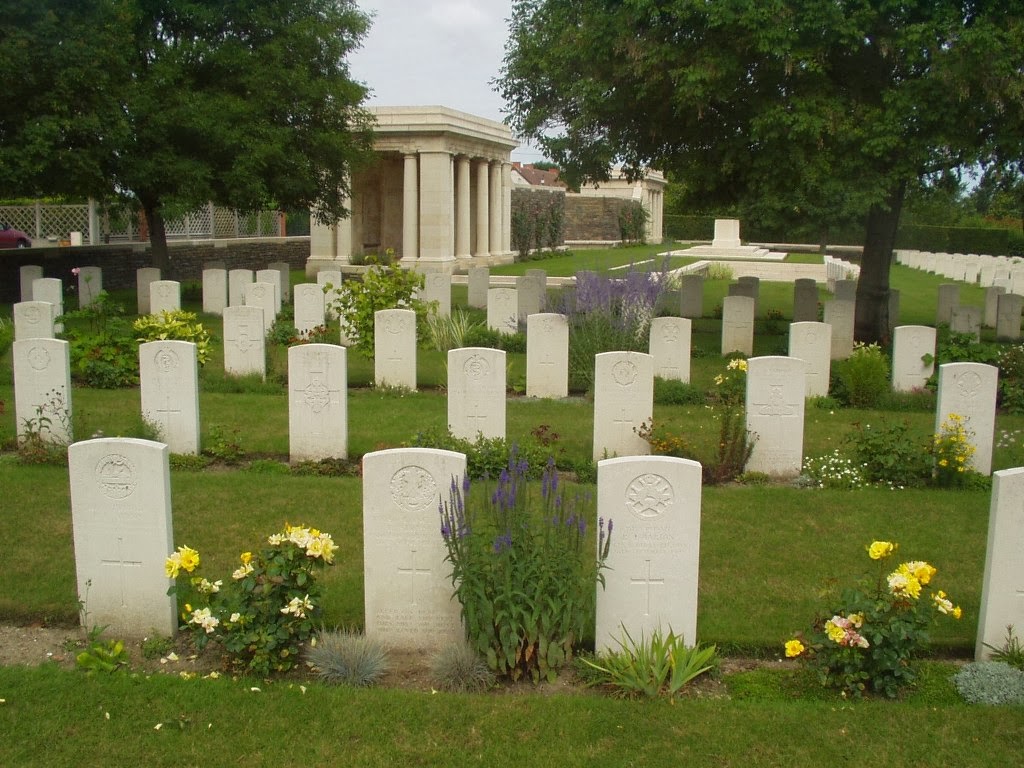
Vermelles British Cemetery


Tuesday, 3 December 2013

Cambrai Aftermath - Two South Midland Losses

Another Division pushed up as a hasty reserve to help stop the German counter-attack at Cambrai, was the 61st (2nd South Midland) Division. The second line units of the South Midland Field Ambulances were attached to this unit and the 2/3rd lost two of it's number on the 5th December, both killed in action and buried at Fins New British Cemetery at Sorel-le-Grand.

Sydney Lawrence Walker
Sydney was born in Carlton, Nottinghamshire. His mother worked in the Cotton Mills and was unmarried but had an older son, and would have a daughter 4 years after Sydney was born in 1891. Sydney lived with his grandparents until moving to Warwickshire to become a Miner, sharing a home with his elder brother, Alfred.

Had he not volunteered in the first month of the War, he might have found himself in the Tunnelling Companies but instead, enlisted into the 1st South Midland Field Ambulance at Warwick as a General Duties Private, Regt Number 1993. The unit was attached to the 48th Division and they landed in France on 30th March 1915. 

Returned to next of kin.....
Sydney was then struck down with Measles in April 1916 and did not return to his unit for a month. He was then transferred to the second line units serving with 61st Division and attached to 2/3rd South Midland Field Ambulance, our unit from the Bristol area. He was promoted to Lance Corporal in August 1916.

His last leave was granted at the end of November 1917, and he was back with his unit for only a couple of days before he was killed on the 5th December, along with Percy Hoddinott. It is likely that they were hit by a shell.


Percival Ernest Hoddinott
Percival was born in 1894 in St Paul's, Bristol. His father, Walter, worked in a stationer's & printer's warehouse and both Percy and his brother would work with him. There were several large Printing works in Bristol at the time and they produced all kinds of good including paper bags, wrapping paper, etc. His elder sister Florence worked a a paper bag folder, probably in the same firm as the male members of the family.

Percy enlisted into the 3rd South Midland Field Ambulance in September 1914 and was given the Service Number 2446. He was posted to the 2/3rd and landed in France on 26th May 1916. He served with the unit throughout and took his last leave in August of 1917. He, too, was with the unit as it supported the move forward of 61st Div, and was killed in action on 2nd December, along with Sydney Walker. They are buried in the same plot at Fins, a Gunner of the Royal Field Artillery between them.


Monday, 2 December 2013

Two "strays" at the Battle of Cambrai 1917


The 30th November 1917 marked a significant point in the Battle of Cambrai. This battle, although arguably not strategically important, began on November 20th when Tanks "en masse" were used for the first time. For the first few days, it was a great success, but the commanders were fired up by success and ordered troops to push on without waiting for reserves and support. Subsequently  the Germans felt that they could counter attack on the 30th November, which they did, with success, and the Allies lost almost all the ground they had gained, and some they held before the attack. 

The Tanks were very effective at first but soon began to break down and many were damaged as they ploughed  through the German lines.The General Staff still believed - after 3 years of trench warfare - that cavalry could still be used to exploit any breakthrough in the line! There was little in the way of infantry reserves to support the advance, and therefore when the Germans unleashed their counter attack, the Allies could not hold on to their gains. Three Divisions in particular were hardest hit in the German advance - 12th (Eastern) Div, 20th (Light) Div and the 55th (West Lancs) to  which 2/1st Wessex Field Ambulance were attached.


Two men of the Wessex Field Ambulances lost their lives on the day of the counter-attack, but were serving with other units at the time.

Thaddeus James Fleming
Thaddeus was born in Crewe, Cheshire in 1892. His father, Thomas Jones Fleming, was a Steam Engine Fitter from Staffordshire but had met Irish lass Mary Cullen in Cheshire, married her and settled in Coppenhall Monks. They had 4 sons and 1 daughter. Then Mary died in 1900 and the three surviving children went to live with an uncle & aunt. Thomas then moved to Plymouth where he married another widower, Catherine Quick and by 1911, the couple had 3 more children and Thomas now worked as a fitter in the Naval Dockyard. Thadeus came down to live with his father and step-mother and started a job as an apprentice brush maker, and he put this down on his attestation form when he joined the 2nd Wessex Field Ambulance in 1909 for a 4 year engagement.

Whilst with the unit, he became a Physical Instructor and re-engaged in 1913 for another 3 years. He was embodied with the rest of his company on 5th August 1914 but did not go overseas with the first line unit which by then had become the 25th. Perhaps as he was a PTI, he was retained at RHQ? Nothing in his records indicates why. 

The Casualty Form from Pte Fleming's Service Records
Whilst at home, he married Bessie Dilling in October, 1914 and their son, Ernest James Kitchener Fleming was born in February 1915. Just over a year later he went to France and was attached to the 62nd Field Ambulance who were part of the 20th Light Division. They were preparing to take part in the Battle of Cambrai when Thadeus was granted leave at the end of October 1917. He returned on the 31st October and rejoined the 62nd. When the Germans counter attacked on the 30th November, 20th Light Division was one of three Divisions that were said to have "evaporated" before the advancing Germans. Thadeus was posted as Missing, and then as Killed in Action OR Died of Wounds Received in Action. His body was recovered though but not until 20th January 1918 by men of the West Yorkshire Regt . He is buried in Metz en Couture Communal Cemetery extension.

His wife Bessie remarried in 1921 and died in 1956. His son did not marry until he was 55  and died a few years ago.

Archibald Percy Taylor
Although born and bred in Madron, Cornwall, Archie enlisted into the 1st Wessex Field Ambulance in Exeter in September 1914. He was born in 1891, son of William Ambrose Taylor, an accountant for Madron District Council, and Marion Beatrice Adams, native of Madron. He had 3 brothers and a sister, 2 of whom died in the early years of the Great War from natural causes. In 1911, Archie was an assistant to a local Dentist, Mr Herbert Gartrell and this would have attracted him to the Medical Corps.

He disembarked in France on 5th December 1914 with the renamed 24th Field Ambulance and served with them until he transferred to the Royal Engineers and became a motorcycle dispatch rider in the 12th Divisional Signals Regt. As mentioned before, one of the Divisions hardest hit by the German attack on 30th November was the 12th (Eastern) Division, and Archie would have been given urgent messages to deliver up the line.

Dispatch Riders at the ned of their journey
There is an account that he would have had to go through the village of Gonnelieu, which unbeknown to him was in German hands. He never arrived at his destination and was posted as missing, along with 3 other dispatch riders. He was not officially posted as Killed in Action until a year later. His name is now found on the Cambrai Memorial to the Missing at Louverval as well as the 1st Wessex plaque and the Madron War Memorial.

Friday, 29 November 2013

The Volunteer Bands

   It has been a while since I posted to this blog so thought I would re-start with a few photos of that peculiarity of volunteer units in the early 20th Century, the Volunteer Band, which seemed to thrive amongst RAMC units. (Fitting that the only RAMC band that still exists is comprised of Volunteers!)

   Most of 243's antecedent units appeared to have a band at some time in their service. If there wasn't a full brass ensemble, then there would be bugles and drums. In the war, anyone who could play some kind of instrument that they could find whilst behind the lines was drafted in to play at impromptu "smokers" or at Christmas functions. There was always someone!

   This is the Bugle Band of the 3rd South Midland Field Ambulance. The Bass Drum has the inscription "Bristol". The South Midland also had a marching band for many years both before and after the War, led by Bandmaster E T Stephens.


   The above photo is the Band of the Cambourne Detachment of 2nd Wessex Field Ambulance. Most likely taken just before the war as they wear "blues". Some of them also have the Imperial Service Badge on the left chest indicating that they were prepared to serve overseas. This was not initiated until 1912. The picture below shows another band of 2nd Wessex Field Ambulance, but this time from 1915 - 18. The 3/2nd were the third line unit that acted as a recruiting and depot cadre. Some of these men also wear the ISB but there are no service or wounds stripes that can be seen. 


  And lastly, another Bugle band, this time from 3/3rd Wessex Field Ambulance, recruiting in the same area as our "D Det".
                         
    A rather "motley crew" with men of all ages, shapes & sizes! Some wear the issued "Utility" pattern tunic and others the 1914 leather equipment belt. No ISD badges here so I assume these are a mixture of new recruits and "downgraded" men! Let's hope they were a good little band and nevertheless did their bit on lifting the spirits of those going overseas!


Sunday, 3 March 2013

Sgt Ernest Arthur Bastin, MM


Ernest was the brother of Arthur Richard Bastin, who had died just after the war in North Evington War Hospital (see previous post). Ernie had been at camp on Salisbury Plain with the 1st Wessex Field Ambulance when war was declared and he was mobilised straight away as part of 24 Field Ambulance, Regt No: 1759 (later 457072 after the TF re-numbering).

Born in 1883, Ernie was the second son of the Bastin family, with three older siblings, and four younger. He married Clara Sercombe in 1906 and they settled in Churchill Road, St Thomas. Ernie was, by 1911, a Foreman Candle Maker. He does not name the company he worked for but does write down that it was a soap and candle manufacturing company.  J L Thomas had the "Sunlight" Soap factory near the river by St Thomas and it is probably here that Ernest worked. He and Clara also had two children, Ernest Stanley born 1907, and Rosalind born 1909. (Neither would make "old bones").

On the 25th September 1915, Ernie was a Corporal in charge of a squad of Bearers. The 8th Division was taking part in a diversionary attack at Bois Grenier to assist the main effort at the Battle of Loos (somewhat optimistically nicknamed "the Big Push") and Ernie's squad was assisting with picking up wounded from the trenches. For several hours, Ernie coolly led his squad whilst under heavy shell-fire and at one point they were buried by a nearby shell burst. Then, L/Cpl Snow, a member of his party, was wounded in the thigh. He carried him away from danger and dressed the wound, thereby saving the soldier from certain death. For these actions, he was awarded the Military Medal (gazetted over a year later in November 1916).

Sadly, at the end of 1917, his wife Clara died, age 32. We do not know what the cause of her death was, but only a few lines in the local paper denote that she was sadly missed by her husband, Ernie, serving with 24th Field Ambulance. We do not know whether Sgt Bastin was allowed home to care for his young children, although he had a large extended family who would have looked after them. They would have been called in to help once again, when Ernie died just over two years after his brother on the 3rd March 1921. He was buried under a CWGC headstone in St Thomas' Cemetery, which indicates that he was probably still serving in the Army at the time. He is also commemorated on the Plaque in Exeter Cathedral.

The Bastins also had another brother, Sydney, who became a S/Sgt in the RAMC during the war. Bastin was a common Devon name and many served, and died, during the war.