Sunday, 15 December 2013

Captain Frank William Lillie

  Lucy Gowlett, my 3rd cousin, married Charles William Lillie on the 4th October 1887 in Radwinter, Essex. Charles had an Ironmongers business and although also from Essex too, moved to Northern climes, first to Leicestershire and then to Macclesfield in Cheshire.  Here, Frank William was born in 1891, his second child and first son. There were 9 Lillie children, the 3 youngest born in Yorkshire where they lived from around the turn of the century. 

  Frank worked in the Business. His younger brother was a draughtsman and at the end of the war was working for Rolls Royce. Their 7 sisters helped in the shop or at home, and the eldest was a teacher. When war broke out in 1914, Frank joined the 15th Bn of the West Yorkshire Regt, raised by the Lord Mayor of Leeds in September 1915. As a member of Yarnbury Rugby Football Club, he may have shown leadership qualities right from the start as the club was affiliated to the Leeds Rifles Regiment, and several of the men played in the team. Thus, he was made a Sergeant.


   The Battalion moved to Ripon for training but before Frank could go overseas with them, he was picked as a likely candidate for Commission and on 4th June 1915, became a 2nd Lieutenant with the King's Own Yorkshire Light Infantry.
He was to serve with the 9th Battalion, another Kitchener Battalion that landed in France in September 1915, but he did not join them until 1916, having arrived in France just after the Battle of the Somme had begun. 


  9th KOYLI had already been involved in the Somme offensive right from the start, and continued to play their part in many of the major battles of the Somme until the campaign fizzled out in November. They were then to hold the line over the winter period, and would be there in the early months of 1917, when the Germans retreated to the Hindenburg line.

  Frank was an Acting Captain in December 1916. Some time on the 18th, he was killed in action. He was buried in Vermelles British Cemetery, which was the cemetery which served that part of the front, and was also used by several medical units. I am yet to confirm his name on a local War Memorial.
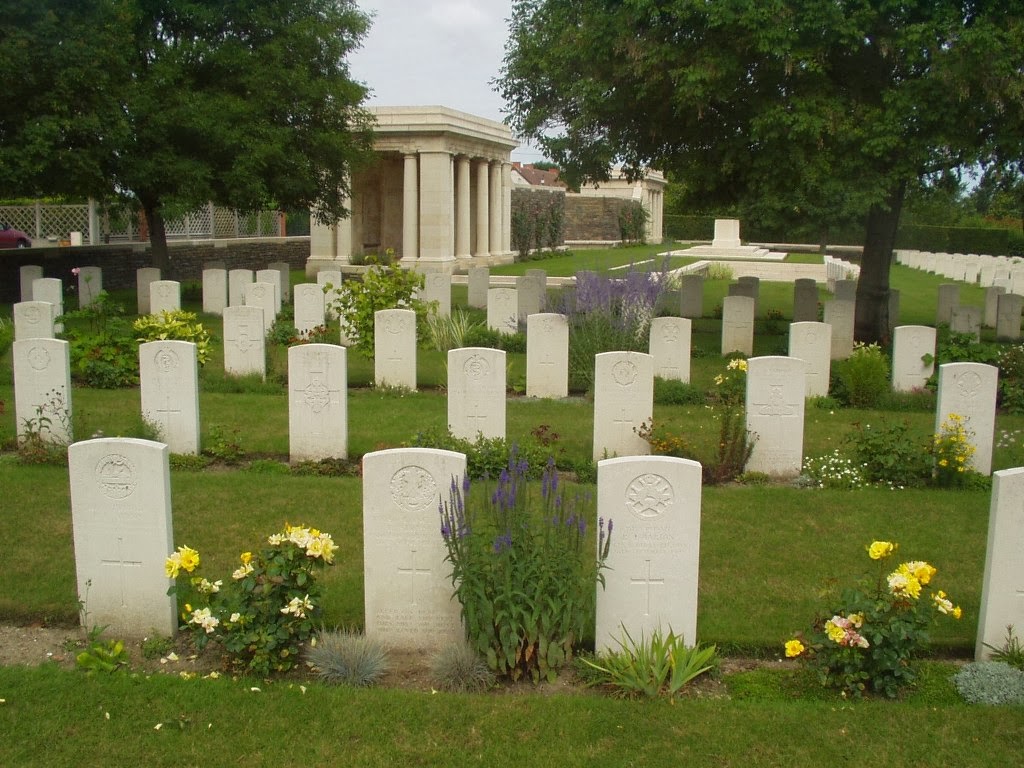


Vermelles British Cemetery


Tuesday, 3 December 2013

Cambrai Aftermath - Two South Midland Losses

Another Division pushed up as a hasty reserve to help stop the German counter-attack at Cambrai, was the 61st (2nd South Midland) Division. The second line units of the South Midland Field Ambulances were attached to this unit and the 2/3rd lost two of it's number on the 5th December, both killed in action and buried at Fins New British Cemetery at Sorel-le-Grand.

Sydney Lawrence Walker
Sydney was born in Carlton, Nottinghamshire. His mother worked in the Cotton Mills and was unmarried but had an older son, and would have a daughter 4 years after Sydney was born in 1891. Sydney lived with his grandparents until moving to Warwickshire to become a Miner, sharing a home with his elder brother, Alfred.

Had he not volunteered in the first month of the War, he might have found himself in the Tunnelling Companies but instead, enlisted into the 1st South Midland Field Ambulance at Warwick as a General Duties Private, Regt Number 1993. The unit was attached to the 48th Division and they landed in France on 30th March 1915. 

Returned to next of kin.....
Sydney was then struck down with Measles in April 1916 and did not return to his unit for a month. He was then transferred to the second line units serving with 61st Division and attached to 2/3rd South Midland Field Ambulance, our unit from the Bristol area. He was promoted to Lance Corporal in August 1916.

His last leave was granted at the end of November 1917, and he was back with his unit for only a couple of days before he was killed on the 5th December, along with Percy Hoddinott. It is likely that they were hit by a shell.


Percival Ernest Hoddinott
Percival was born in 1894 in St Paul's, Bristol. His father, Walter, worked in a stationer's & printer's warehouse and both Percy and his brother would work with him. There were several large Printing works in Bristol at the time and they produced all kinds of good including paper bags, wrapping paper, etc. His elder sister Florence worked a a paper bag folder, probably in the same firm as the male members of the family.

Percy enlisted into the 3rd South Midland Field Ambulance in September 1914 and was given the Service Number 2446. He was posted to the 2/3rd and landed in France on 26th May 1916. He served with the unit throughout and took his last leave in August of 1917. He, too, was with the unit as it supported the move forward of 61st Div, and was killed in action on 2nd December, along with Sydney Walker. They are buried in the same plot at Fins, a Gunner of the Royal Field Artillery between them.


Monday, 2 December 2013

Two "strays" at the Battle of Cambrai 1917


The 30th November 1917 marked a significant point in the Battle of Cambrai. This battle, although arguably not strategically important, began on November 20th when Tanks "en masse" were used for the first time. For the first few days, it was a great success, but the commanders were fired up by success and ordered troops to push on without waiting for reserves and support. Subsequently  the Germans felt that they could counter attack on the 30th November, which they did, with success, and the Allies lost almost all the ground they had gained, and some they held before the attack. 

The Tanks were very effective at first but soon began to break down and many were damaged as they ploughed  through the German lines.The General Staff still believed - after 3 years of trench warfare - that cavalry could still be used to exploit any breakthrough in the line! There was little in the way of infantry reserves to support the advance, and therefore when the Germans unleashed their counter attack, the Allies could not hold on to their gains. Three Divisions in particular were hardest hit in the German advance - 12th (Eastern) Div, 20th (Light) Div and the 55th (West Lancs) to  which 2/1st Wessex Field Ambulance were attached.


Two men of the Wessex Field Ambulances lost their lives on the day of the counter-attack, but were serving with other units at the time.

Thaddeus James Fleming
Thaddeus was born in Crewe, Cheshire in 1892. His father, Thomas Jones Fleming, was a Steam Engine Fitter from Staffordshire but had met Irish lass Mary Cullen in Cheshire, married her and settled in Coppenhall Monks. They had 4 sons and 1 daughter. Then Mary died in 1900 and the three surviving children went to live with an uncle & aunt. Thomas then moved to Plymouth where he married another widower, Catherine Quick and by 1911, the couple had 3 more children and Thomas now worked as a fitter in the Naval Dockyard. Thadeus came down to live with his father and step-mother and started a job as an apprentice brush maker, and he put this down on his attestation form when he joined the 2nd Wessex Field Ambulance in 1909 for a 4 year engagement.

Whilst with the unit, he became a Physical Instructor and re-engaged in 1913 for another 3 years. He was embodied with the rest of his company on 5th August 1914 but did not go overseas with the first line unit which by then had become the 25th. Perhaps as he was a PTI, he was retained at RHQ? Nothing in his records indicates why. 

The Casualty Form from Pte Fleming's Service Records
Whilst at home, he married Bessie Dilling in October, 1914 and their son, Ernest James Kitchener Fleming was born in February 1915. Just over a year later he went to France and was attached to the 62nd Field Ambulance who were part of the 20th Light Division. They were preparing to take part in the Battle of Cambrai when Thadeus was granted leave at the end of October 1917. He returned on the 31st October and rejoined the 62nd. When the Germans counter attacked on the 30th November, 20th Light Division was one of three Divisions that were said to have "evaporated" before the advancing Germans. Thadeus was posted as Missing, and then as Killed in Action OR Died of Wounds Received in Action. His body was recovered though but not until 20th January 1918 by men of the West Yorkshire Regt . He is buried in Metz en Couture Communal Cemetery extension.

His wife Bessie remarried in 1921 and died in 1956. His son did not marry until he was 55  and died a few years ago.

Archibald Percy Taylor
Although born and bred in Madron, Cornwall, Archie enlisted into the 1st Wessex Field Ambulance in Exeter in September 1914. He was born in 1891, son of William Ambrose Taylor, an accountant for Madron District Council, and Marion Beatrice Adams, native of Madron. He had 3 brothers and a sister, 2 of whom died in the early years of the Great War from natural causes. In 1911, Archie was an assistant to a local Dentist, Mr Herbert Gartrell and this would have attracted him to the Medical Corps.

He disembarked in France on 5th December 1914 with the renamed 24th Field Ambulance and served with them until he transferred to the Royal Engineers and became a motorcycle dispatch rider in the 12th Divisional Signals Regt. As mentioned before, one of the Divisions hardest hit by the German attack on 30th November was the 12th (Eastern) Division, and Archie would have been given urgent messages to deliver up the line.

Dispatch Riders at the ned of their journey
There is an account that he would have had to go through the village of Gonnelieu, which unbeknown to him was in German hands. He never arrived at his destination and was posted as missing, along with 3 other dispatch riders. He was not officially posted as Killed in Action until a year later. His name is now found on the Cambrai Memorial to the Missing at Louverval as well as the 1st Wessex plaque and the Madron War Memorial.

Friday, 29 November 2013

The Volunteer Bands

   It has been a while since I posted to this blog so thought I would re-start with a few photos of that peculiarity of volunteer units in the early 20th Century, the Volunteer Band, which seemed to thrive amongst RAMC units. (Fitting that the only RAMC band that still exists is comprised of Volunteers!)

   Most of 243's antecedent units appeared to have a band at some time in their service. If there wasn't a full brass ensemble, then there would be bugles and drums. In the war, anyone who could play some kind of instrument that they could find whilst behind the lines was drafted in to play at impromptu "smokers" or at Christmas functions. There was always someone!

   This is the Bugle Band of the 3rd South Midland Field Ambulance. The Bass Drum has the inscription "Bristol". The South Midland also had a marching band for many years both before and after the War, led by Bandmaster E T Stephens.


   The above photo is the Band of the Cambourne Detachment of 2nd Wessex Field Ambulance. Most likely taken just before the war as they wear "blues". Some of them also have the Imperial Service Badge on the left chest indicating that they were prepared to serve overseas. This was not initiated until 1912. The picture below shows another band of 2nd Wessex Field Ambulance, but this time from 1915 - 18. The 3/2nd were the third line unit that acted as a recruiting and depot cadre. Some of these men also wear the ISB but there are no service or wounds stripes that can be seen. 


  And lastly, another Bugle band, this time from 3/3rd Wessex Field Ambulance, recruiting in the same area as our "D Det".
                         
    A rather "motley crew" with men of all ages, shapes & sizes! Some wear the issued "Utility" pattern tunic and others the 1914 leather equipment belt. No ISD badges here so I assume these are a mixture of new recruits and "downgraded" men! Let's hope they were a good little band and nevertheless did their bit on lifting the spirits of those going overseas!


Sunday, 3 March 2013

Sgt Ernest Arthur Bastin, MM


Ernest was the brother of Arthur Richard Bastin, who had died just after the war in North Evington War Hospital (see previous post). Ernie had been at camp on Salisbury Plain with the 1st Wessex Field Ambulance when war was declared and he was mobilised straight away as part of 24 Field Ambulance, Regt No: 1759 (later 457072 after the TF re-numbering).

Born in 1883, Ernie was the second son of the Bastin family, with three older siblings, and four younger. He married Clara Sercombe in 1906 and they settled in Churchill Road, St Thomas. Ernie was, by 1911, a Foreman Candle Maker. He does not name the company he worked for but does write down that it was a soap and candle manufacturing company.  J L Thomas had the "Sunlight" Soap factory near the river by St Thomas and it is probably here that Ernest worked. He and Clara also had two children, Ernest Stanley born 1907, and Rosalind born 1909. (Neither would make "old bones").

On the 25th September 1915, Ernie was a Corporal in charge of a squad of Bearers. The 8th Division was taking part in a diversionary attack at Bois Grenier to assist the main effort at the Battle of Loos (somewhat optimistically nicknamed "the Big Push") and Ernie's squad was assisting with picking up wounded from the trenches. For several hours, Ernie coolly led his squad whilst under heavy shell-fire and at one point they were buried by a nearby shell burst. Then, L/Cpl Snow, a member of his party, was wounded in the thigh. He carried him away from danger and dressed the wound, thereby saving the soldier from certain death. For these actions, he was awarded the Military Medal (gazetted over a year later in November 1916).

Sadly, at the end of 1917, his wife Clara died, age 32. We do not know what the cause of her death was, but only a few lines in the local paper denote that she was sadly missed by her husband, Ernie, serving with 24th Field Ambulance. We do not know whether Sgt Bastin was allowed home to care for his young children, although he had a large extended family who would have looked after them. They would have been called in to help once again, when Ernie died just over two years after his brother on the 3rd March 1921. He was buried under a CWGC headstone in St Thomas' Cemetery, which indicates that he was probably still serving in the Army at the time. He is also commemorated on the Plaque in Exeter Cathedral.

The Bastins also had another brother, Sydney, who became a S/Sgt in the RAMC during the war. Bastin was a common Devon name and many served, and died, during the war.


Wednesday, 20 February 2013

Pte Frank Amos Stock

My 3rd cousin, Frank Stock, was born in Stratford, Essex in 1896. Father Amos was originally from Radwinter, Essex, one of the "ancestral" villages just outside Saffron Walden. Some time between 1881 and 1891, Amos' father Josiah moved the family 50 miles down to the outer London suburb of West Ham. He was a Labourer, and work in that part of Essex was obviously easier to find than that in  a little village as he had tried working for his brother-in-law in Gloucester before relocating with the whole family. Amos went on to marry Alice Boreham in 1891 and they had eight children, Frank being the eldest of five sons.

In 1911, they were living in Forest Gate and Frank had a job as a Shop Messenger for Boots whilst Amos worked for West Ham Council on the road repair gangs.

Post Office Rifles on parade.
Unfortunately, we do not have Franks' Service Records but at some time after the declaration of war, he joined the 8th Battalion of the London Regt, more commonly known as the Post Office Rifles. This Battalion could trace it's history back to the 1860's when the threat from Fenian rebels in Ireland was so great that men from the Post Office were made Special Constables to protect the Post Office buildings from being attacked. They then became a volunteer battalion of the Middlesex Regt and actually did duty as the Army Post Office  Corps until that job was taken over by the Royal Engineers. When the Territorial Force came into existence, the Volunteer postmen became the 8th Bn, London Regt (Post Office Rifles). During the war, two battalions were sent to fight with the BEF, with the 2/8th distinguishing itself at Ypres ("The Battle of Wurst Farm Ridge") where a Sergeant won their only Victoria Cross. Frank may have worked for the Post Office at the time, but later in the war, the battalion did not recruit exclusively from the GPO.

At the beginning of February 1918, the two battalions were amalgamated and came under command of the 58th Division. The Post Office Rifles would take part in the last battles in France and the advance into Germany, but on 20th February, Frank died of wounds received in action. He was buried in one of the small burial grounds that populated the French countryside but after the Armistice, was reburied in Chauny Communal Cemetery British Extension where there are now over 1000 graves, mostly from 1918. Up to now, I cannot find his name on any local war memorial, but he will not be forgotten.


His father, Amos, died in 1947 in East Ham, and his wife Alice died three years later. Of his siblings, brother George served in the Royal Artillery. The last of them, sister Lillian, died in 1993 in Brentwood.


Pte Henry Gilbert Edmondson

Henry Edmondson was another member of the 3rd South Midland Field Ambulance who did not set foot in France before his death in Chelmsford in 1915. He died two weeks after his colleague, Ernie Stone, on the 19th February 1915 and is buried nearby. He was 18, the youngest son of the late Edward Edmondson and his second wife Amelia. There was an elder brother, Edward, who served with the Army Veterinary Corps, and a middle brother, Albert, who also went on to serve in the RAMC in a General Hospital in France later in the War. There were also two elder sisters from his father's first wife.

The family lived in Bristol where his father was a General Labourer. He died in 1901 and Amelia became a charwoman to keep the family together. In 1911, they were living in Gay Street, near King Square. Today, it is an area of upmarket housing and office suites, but the little side streets away from the square, remind us of what the area may have been. There is still a cobbled street amongst the modern buildings. The family moved several times, but always in the area. This was not uncommon at the time, but they did seem to settle for some years in Montague Street, after Henry was killed, as his brother Albert, whose Service Records survive, was called up from that address in 1917 and wrote a letter requesting a reference in 1920 from the same address. In 1924, he also applied to the War Office for Henry's medal, but although there is a Medal Index Card, there is no mention of a medal roll number. As he did not serve overseas, he may not have been eligible, but he should have had the Silver War Badge, authorised in 1916 for personnel wounded or discharged sick from any theatre. It seems sad that both Ernie Stone and Henry were left with no commemoration (except the "dead man's penny" perhaps?) even though they died in service. At least Henry's name is found on the 3rd South Midland Plaque in Bristol Cathedral and this blog will remember them.